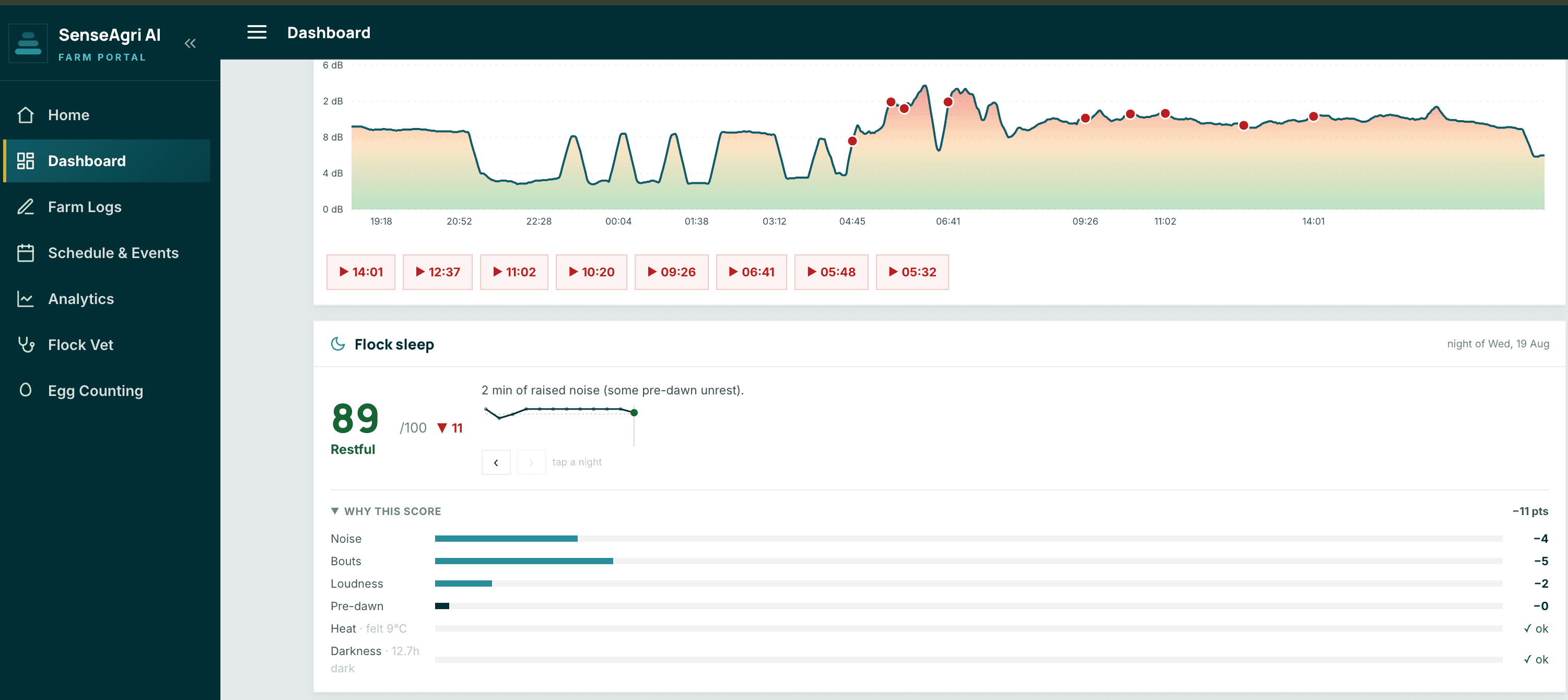
Sleep drives health, welfare and laying, yet until now no one could see it. SenseAgri AI turns an existing shed microphone and a handful of IoT sensors into a simple, nightly window on the flock’s night.
How it works
No new cameras, no wearables, nothing that touches the birds.
- 1.Listen — A microphone in the shed captures the flock through the night: how much of the whole flock is stirring, not just one loud bang.
- 2.Sense — IoT sensors log temperature, humidity and light every minute — the conditions that make or break a bird's rest.
- 3.Score — Each night is scored 0–100 against research-backed thresholds, combining six factors into one clear number.
- 4.Tell — The score, the trend, and the reason land on the farmer's phone, with a WhatsApp alert only when something needs attention.
What the score measures
A perfect, undisturbed night is 100. Each problem takes points off.
| Factor | What it means |
|---|---|
| Noise | How much of the night the flock was raised and vocal — the main measure of disturbance across the whole flock. |
| Bouts | How many separate times they were unsettled. Repeated waking is worse than one long event. |
| Loudness | How intense the disturbance was, not just how long — a sudden fright reads differently from mild restlessness. |
| Pre-dawn | Disruption in the hours before first light, weighted heavily — the window where deep, restorative REM sleep matters most. |
| Experienced heat | Temperature and humidity combined into a “feels-like” °C — because a bird cools by panting and can't shed humid heat. Heat is the first thing to rob a hen of REM sleep. |
| Darkness | Whether the flock got enough dark to rest — hens only sleep in the dark. Too little (long summer days, lights left on) costs them; plenty is free. |
- 85–100 · Restful — undisturbed rest
- 60–85 · Some disruption — worth a look
- Below 60 · Disturbed — something needs attention
What the farmer gets
“The birds seem unsettled lately” becomes something measured — and actionable.
- ✓Last night's score, clear and simple, with the trend across recent nights.
- ✓A plain-language reason for it — noise, heat, or not enough darkness.
- ✓A WhatsApp alert only when rest has been poor several nights running — with the likely cause.
- ✓The actual audio clips of the disturbance, to listen to and judge for themselves.
The science behind it
The score isn’t guesswork — its thresholds are grounded in peer-reviewed poultry research.
Hens sleep almost entirely in the dark — roughly 60% deep (slow-wave) sleep and 12% REM during lights-off; in daylight they barely sleep at all. This is why we score the night, and why darkness matters.
— Putyora et al. (2023), Animals 13(19):3105
Heat is the biggest disruptor of sleep — it nearly eliminated REM sleep in EEG studies, and can rob a hen of rest even when she's quiet — so we measure it directly.
— Putyora et al. (2023), Animals
A single rough night is recovered; repeated ones aren't — brief disturbances are compensated the same night, so we alert on sustained poor sleep, not one-offs.
— Putyora et al. (2023), “Mild Disturbances,” Animals
Sustained heat erodes production — feed intake and egg output fall as heat rises, with egg quality degrading first. Sleep, heat and production sit on the same chain.
— Animals (2024) 14(7):1076
Red mite nearly doubles night-time restlessness — under infestation, dark-period activity roughly doubled and stayed high all night. Because the score is built to detect restless, disturbed nights, an outbreak shows up as sustained poor sleep.
— Willems et al. (2025), Animals 15(19):2928
Why it matters
Poor sleep is a leading indicator — it often moves before the egg count does.
- →Welfare, made visible — A continuous, non-invasive read on how well the flock is resting, night to night.
- →Points to the cause — Heat, a broken dark period, or repeated disturbance — so the farmer knows where to look.
- →An early-warning system — Persistent poor sleep can flag heat stress, disturbance, or a building red-mite problem before it shows up in production.
Where we are today: the score is a validated welfare and early-warning signal, built from sound and environment — a practical, farm-ready measure. Linking it to production numbers is what we’re validating next, on each farm’s own data.
Last updated: 20 August 2026